Does Math Expressions Align to the 2026 New Minnesota Math Standards?
 Shannon Kiebler
Does Math Expressions align to the new 2026 Minnesota Math Standards? See what changed, where it's already strong, and what educators should know.
"Does Math Expressions align to the new Minnesota Math Standards?"
It's one of the most common questions I've been hearing from Minnesota educators.
It's a reasonable question. After all, when new standards are adopted, teachers, instructional coaches, principals, and curriculum leaders naturally want to know whether the resources they've been using will continue to support student learning.
But after spending months working through the new Minnesota benchmarks alongside the Math Expressions curriculum, I've come to learn that it's actually a strong fit.
Now that I can confidently say that Math Expressions does align, we need to dive into how it aligns.
When Standards Change, It's Easy to Jump to Conclusions
Whenever a state adopts new academic standards, there's often a sense of urgency.
Teachers wonder how much they need to change before students arrive.
Instructional coaches begin thinking about professional learning.
Administrators start asking whether pacing guides need to be rewritten or whether it's time to begin exploring new curriculum resources.
Those are important conversations, but they often happen before anyone has a complete picture of what's actually changing.
It's easy to assume that new standards automatically mean a curriculum is no longer effective.
In my experience, that's rarely the case.
Most curriculum resources—including Math Expressions—already address many of the mathematical ideas students are expected to learn. The challenge isn't that everything is different.
The challenge is understanding exactly where the differences are.
Some benchmarks have shifted grade levels. Some have been strengthened or clarified. Others represent entirely new expectations that are unique to Minnesota. But in reality, many haven't changed nearly as much as people expect.
Without taking the time to understand those differences, it's difficult to know whether you're looking at a curriculum issue, an instructional emphasis, or simply a change in wording.
Those are very different problems, and they deserve very different solutions.
Before You Replace Math Expressions, Ask Better Questions
One conversation I've seen happen more than once goes something like this:
"The standards changed...maybe we need a new curriculum."
Maybe.
But most likely not.
A curriculum shouldn't be evaluated by checking whether every benchmark appears in the table of contents. It should be evaluated by looking at what students are actually being asked to understand, say, do, and apply throughout the learning process.
Sometimes a lesson already develops the mathematical thinking behind a benchmark, even if the language doesn't match word for word.
Sometimes teachers simply need to place greater emphasis on an idea that's already embedded in the curriculum.
Sometimes a reasoning routine, a rich discussion, or a supplemental task is all that's needed to strengthen alignment.
And yes, occasionally there are benchmarks that truly require additional instructional support.
Those are very different decisions.
Unfortunately, many schools are trying to make them before they have all of the information.
The Work I've Been Doing With Minnesota's 2026 Math Standards
Over the past several months, I've spent countless hours studying the new Minnesota Math Standards alongside the Math Expressions curriculum...for every single grade level.
My goal wasn't simply to compare unit titles or pacing guides. I wanted to understand how the lessons students experience every day connect to the mathematical thinking described in the new benchmarks.
That meant looking carefully at each benchmark, each lesson, and the instructional intent behind both. I wanted to answer the questions I kept hearing from teachers and school leaders.
Where is Math Expressions already providing strong support?
Where would teachers benefit from placing additional emphasis?
Which benchmarks are truly unique to Minnesota?
And what practical adjustments will have the greatest impact without creating unnecessary work?
Those answers matter because they help schools make informed decisions. They help teachers prioritize their planning. And most importantly, they keep districts from spending valuable time solving problems they don't actually have.
Because not every difference requires a new lesson. Not every new benchmark requires a new curriculum. Sometimes it simply requires a clearer understanding of what's already there.
Minnesota's New Math Standards Don't Mean More Work
One of the things I appreciate most about educators is that we want to do what's best for students.
When new standards are introduced, our instinct is to work harder.
We start highlighting documents, comparing benchmarks, creating spreadsheets, revising pacing guides, and searching for additional resources.
There's certainly a place for that work.
But before investing countless hours making changes, it's worth exploring what actually needs to change. Because when we understand where Math Expressions already aligns, where instruction can be strengthened, and where Minnesota has introduced something genuinely new, we can make thoughtful decisions instead of reactive ones.
That's better for teachers.
It's better for schools.
And ultimately, it's better for students.
Your First Step Toward Math Expressions Alignment
Before rewriting pacing guides...
Before creating supplemental lessons...
Before deciding whether your district needs new curriculum resources...
Take the time to understand where you already are.
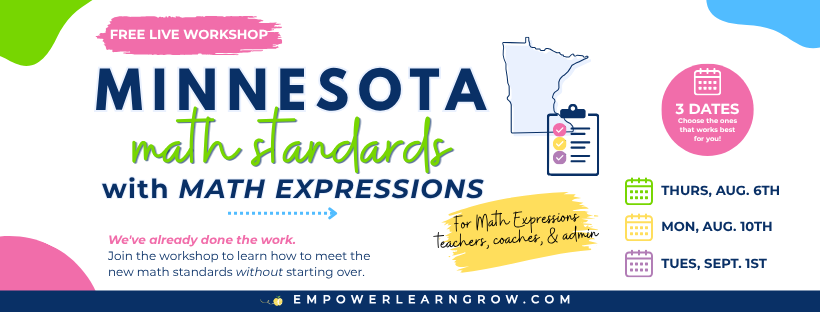
That's exactly why I created a free workshop: Minnesota Math Standards with Math Expressions.
During this free workshop, I'll walk through the biggest shifts in the new standards, show where Math Expressions already provides strong support, identify the benchmarks that deserve additional attention, and help you understand what's needed to move forward.
If you attend the workshops live, you'll also receive a free Minnesota math standards alignment download for your grade level. It details which standards are staying the same and which ones need supplemental support.
Whether you're a classroom teacher, instructional coach, principal, or district leader, my goal is simple:replace uncertainty with clarity.
Save your spot to the Free Minnesota Math Standards Workshop
Categories: : back to school