What Hot Pot Can Teach Math Expressions Leaders About Curriculum Implementation
 Shannon Kiebler


How guidance and clarity turns the Math Expressions curriculum into meaningful implementation.
We have a new hot pot place by where I live.
I’m not generally a fan of paying to cook my own food, but I promised my husband I would give it a go.
In case you’re unfamiliar, they give you your own burner, a pot of broth, and then you choose the meat, seafood, vegetables, noodles, sauces, and seasonings you want.
I don’t love ambiguity.
I know what I like in terms of spicy, sweet, etc., but I don’t necessarily know how to achieve the taste I want.
I am a recipe person. I am a map person. I read assembly directions.
For better or for worse, I don’t really do “play and figure it out.” I know the end result, and I’d like a roadmap to get there.
So during my inaugural hot pot experience, I confidently arrived at the seasoning and sauce bar and started adding things to bowls.
If it sounded like an ingredient I liked, I added it.
No idea how much was too much or too little. Did those flavors actually go together?
The outcome? Hodgepodge.
Was it edible? Yes. Was it gourmet? Not by a long shot.
I left frustrated. The meal was expensive, and my argument as we left was, “Why couldn’t they provide suggestions and even a little guidance?”
There’s another Mongolian BBQ place downtown we went to in college. I still daydream about that place. Why?
They had posted recipes.
A ladle of this. A pinch of that. Could I still vary it? Add a few more jalapeños or a little less soy sauce? Absolutely. But having a template to start from made all the difference.
Resources are not the same as guidance.
We do this in teaching ALL the time.
We give teachers curricular resources, all the bells and whistles, and think: Give them everything they may need and they can decide what to use, when, how much, how little.
It’s a lack of clarity disguised as autonomy.
There will always be teachers who can take the resources and orchestrate lessons. They know enough about the curriculum, their students, and their goals to modify, differentiate, and be flexible. These are the trained chefs in my hot pot story.
But even they had to have enough experience to get to that point.
I’m not suggesting we take away the play or the struggle.
Confidence comes from learning, trying, getting feedback, and building enough skill to recover when something doesn’t work.
But when people have experienced enough failure doing it on their own, experimenting starts to feel risky.
A roadmap, or even just a coach, gives us confidence to start.
If someone had simply said, “You can add another ladle of soy sauce, but you may find it too salty,” the decision still would have been mine.
They just would have given me enough information to make a better one.
That’s the point.
Provide guidance. Provide coaching. Provide templates. Provide clarity. Provide the foundation.
Tell teachers what has to be in the pot to get the desired outcome, then let them adjust the seasoning from there.
Initial training is not enough.
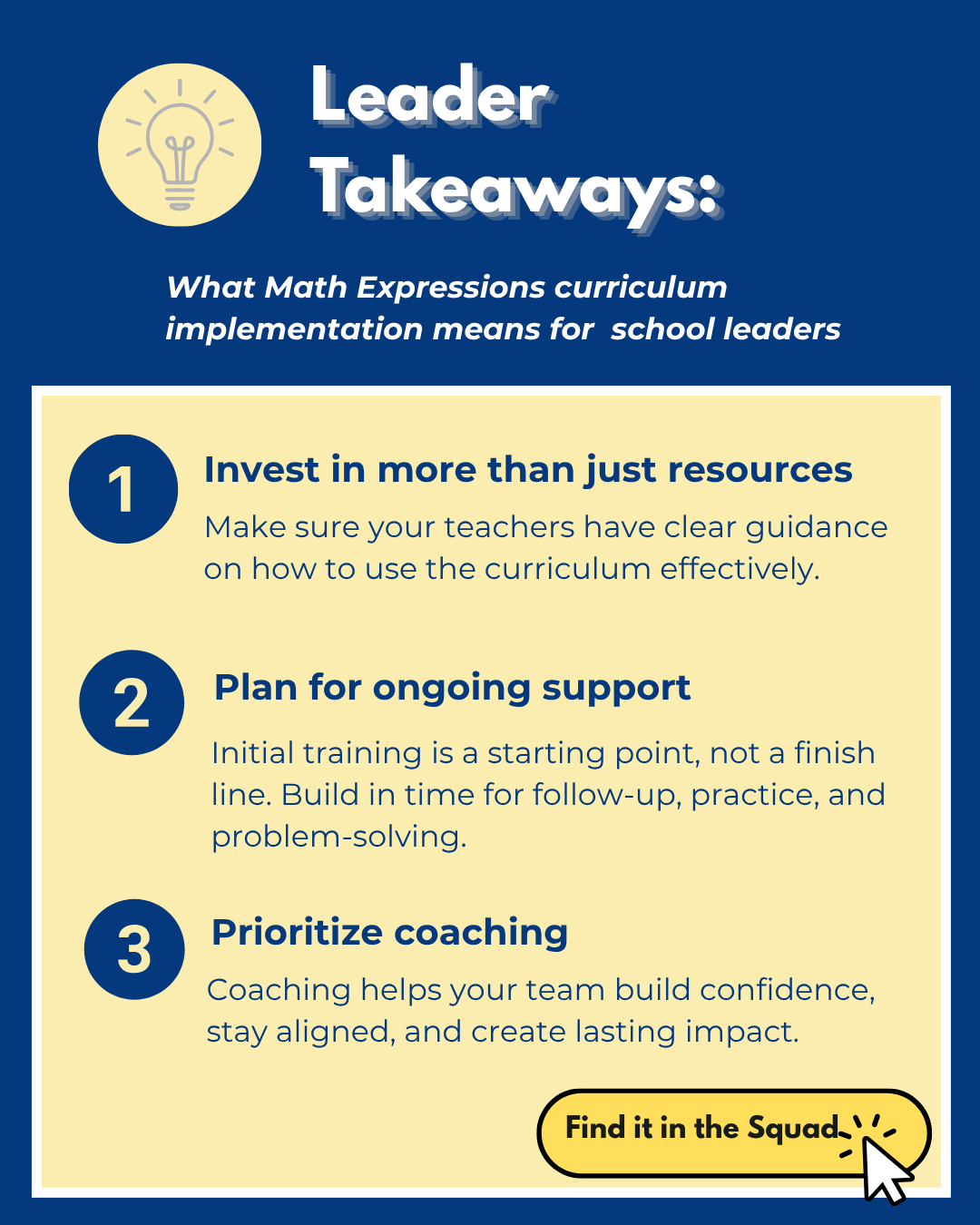
The number of schools I talk to that provide curriculum but very little guidance on what it looks like to use it, when to use it, how often, or which parts matter most still astounds me.
“So what math training using the curriculum have teachers had?”
The most common answer?
“The initial training.”
A two-hour publisher training doesn’t make you a master.
It introduces the parts. It doesn’t necessarily teach you how to best combine them.
And too often, there is little to no coaching beyond that initial training.
Coaching creates confidence and coherence.
Coaching’s most important role is to build confidence and independence.
Even strong teachers need to understand the pieces before they can orchestrate them effectively.
Otherwise, they revert back to what they know works, leaving behind the expensive tools you’ve given them. Not because the tools don’t work, but because they don’t know what they don’t know.
That is where coherence starts to break down.
Curriculum provides coherence. Varied use of curriculum yields varied results.
The cost of ambiguity.
I want teachers to become masters too, and they can.
But ambiguity is an expensive meal for varied results.
And next time, I’m just going to a normal restaurant.
Ambiguity is also an expensive curriculum with varied results.
And without guidance, next time teachers are just going to pull out the old materials and hope for the best. How much guidance have your teachers gotten after that initial curriculum training?